
Four Blue Petals, One Galaxy — The Einstein Cross That Turns Gravity into a Cosmic Lens
Author: Dhinakar Rajaram
Reading time: Approximately 12–15 minutes in English; approximately 22–26 minutes for the complete English–Tamil bilingual version.
Four blue images. One distant galaxy. A foreground galaxy turns its gravity into a cosmic lens.
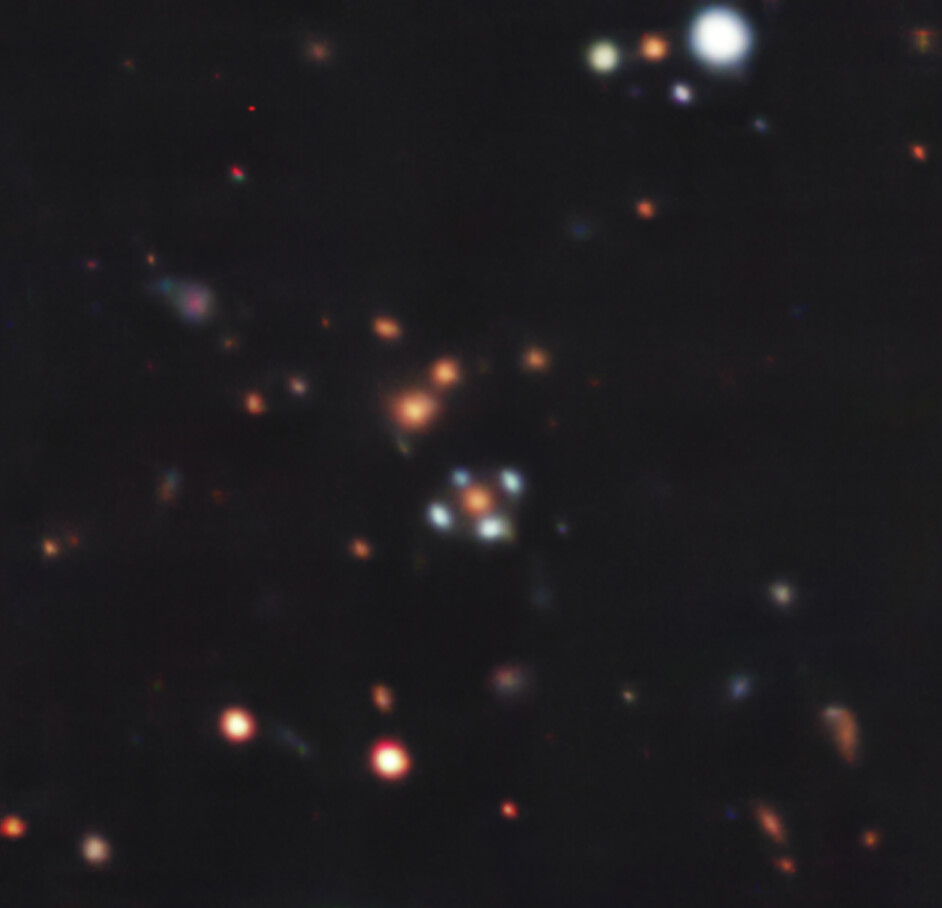
Image: ESO/A. Cikota et al. — the four blue points are four gravitationally lensed images of the same distant background galaxy.
Translation Option / மொழிபெயர்ப்பு விருப்பம்
Readers may use the translation facility provided by Blogger, or their web browser's translation facility, to read this article in Tamil or another preferred language. The English version is the original and authoritative version of the essay. The Tamil section below is provided as a carefully written scientific rendering rather than as a word-for-word machine translation. For technical terminology, numerical values, and scientific nuance, the English original should remain the reference.
வாசகர்கள் Blogger-இல் வழங்கப்படும் மொழிபெயர்ப்பு வசதியையோ, இணைய உலாவியின் மொழிபெயர்ப்பு வசதியையோ பயன்படுத்தி, இந்தக் கட்டுரையைத் தமிழ் அல்லது தங்களுக்கு விருப்பமான பிற மொழியில் வாசிக்கலாம். கீழே வழங்கப்பட்டுள்ள தமிழ் பகுதி சொற்சொறான இயந்திர மொழிபெயர்ப்பு அல்ல; அறிவியல் பொருளைத் துல்லியமாகத் தெரிவிக்கும் வகையில் எழுதப்பட்டுள்ளது. அறிவியல் கலைச்சொற்கள், எண் மதிப்புகள், மற்றும் நுணுக்கமான விளக்கங்களுக்கு ஆங்கில மூலப்பதிப்பே அதிகாரப்பூர்வமான குறிப்பாகும்.
Choose your language / உங்கள் மொழியைத் தேர்ந்தெடுக்கவும்
Constitutional Requirement — Article 51A(h) / அரசியலமைப்புச் சார்ந்த கடமை — 51A(h)
Article 51A(h) of the Constitution of India calls upon every citizen to develop the scientific temper, humanism, and the spirit of inquiry and reform. Astronomy gives that principle a particularly fine field of exercise. A striking picture need not be accepted merely because it is striking; it can be interrogated. What are we actually seeing? How do we know that the four blue points belong to one galaxy? What measurement distinguishes a gravitational lens from a mere chance alignment?
இந்திய அரசியலமைப்பின் 51A(h) பிரிவு, அறிவியல் மனப்பான்மை, மனிதநேயம், ஆய்வு மற்றும் சீர்திருத்த உணர்வு ஆகியவற்றை வளர்த்துக் கொள்வது ஒவ்வொரு குடிமகனின் கடமை எனக் கூறுகிறது. வானியல், இந்த அறிவியல் மனப்பான்மையை நடைமுறையில் பயன்படுத்துவதற்கான சிறந்த துறைகளில் ஒன்றாகும். கண்ணைக் கவரும் ஒரு படம் என்பதற்காக அதிலுள்ள தோற்றத்தை அப்படியே ஏற்றுக்கொள்ள வேண்டியதில்லை. “நாம் உண்மையில் எதைப் பார்க்கிறோம்?”, “நான்கு நீல ஒளிப்புள்ளிகளும் ஒரே விண்மீன் திரளுக்குச் சேர்ந்தவை என்பதை எவ்வாறு அறிகிறோம்?”, “இது ஈர்ப்புவிசை லென்சிங் என்பதற்கு என்ன அளவீட்டு ஆதாரம் உள்ளது?” போன்ற கேள்விகளே அறிவியல் ஆய்வின் தொடக்கம்.
About the Author / ஆசிரியரைப் பற்றி
I am Dhinakar Rajaram, an independent science writer, science communicator, amateur astronomer, and astronomy outreach volunteer based in Chennai. My interests extend across astronomy, science, technology, engineering, history, and the ways in which scientific knowledge intersects with human culture and everyday life.
My formal engagement with astronomy dates from 2010, although my fascination with the night sky began in childhood. I am a founding member of the Tamil Nadu Astronomical Society, and I have taken part in astronomy outreach, public observation programmes, and activities concerned with understanding the sky.
I am not a professional astronomer. I write as an interested observer and communicator who believes that a remarkable astronomical image is often only the beginning of a better question. My aim is to explain what the observation establishes, what the mathematics and instruments add to the story, and where an attractive interpretation must still be kept on a short scientific leash.
Foreword
There are photographs of the Universe which are beautiful. There are others which are useful. And then there are a few which seem to pull the scientific carpet from beneath our ordinary intuition.
This is one of them.
At the centre of the picture sits a comparatively nearer, orange-looking galaxy. Around it appear four pale-blue points, arranged rather like the petals of a small cosmic flower. At first glance, the obvious conclusion would be that the photograph contains several separate galaxies clustered together. The Universe, however, has performed a rather neat piece of sleight of hand.
The four blue images are not four background galaxies. They are four separate images of one and the same distant galaxy. The intervening galaxy has bent the light on its journey to us, so that the distant source is seen along several gravitationally deflected paths.
The system is known as DESI-253.2534+26.8843, and its configuration is an Einstein Cross. Observations with the Multi Unit Spectroscopic Explorer (MUSE) on ESO's Very Large Telescope in Chile did more than produce an attractive picture: spectroscopy established that the four blue images share the same source redshift, confirming their common origin.
In other words, this is not merely a pretty cosmic coincidence. It is a piece of observational evidence for curved spacetime made visible on an astronomical scale.
Preface — When One Galaxy Pretends to Be Four
Our eyes are accustomed to treating an image as a map of where objects are. If four lamps appear around a central object, we naturally suppose there are four lamps. Astronomy repeatedly teaches us that this intuition can be a dangerous guide when light has travelled across intergalactic space.
Light does not always reach us by an apparently straight route. According to general relativity, mass and energy alter the geometry of spacetime. A photon travelling through the neighbourhood of a sufficiently massive object follows a path determined by that curved geometry. From our vantage point, the effect appears as a bending of light.
When a foreground galaxy lies almost along the line of sight to a more distant galaxy, its gravitational field can act as a gravitational lens. The background galaxy may then be magnified, distorted, stretched into an arc, or — under a particularly favourable alignment — split into multiple apparent images.
The Einstein Cross is the four-image version of that cosmic trick. The geometry is not a matter of the background galaxy physically being torn into four pieces. The source remains one galaxy. It is the light paths that have multiplied.
1. The Cosmic Arrangement Behind the Illusion
The system was identified as a strong gravitational lens in the DESI Legacy Imaging Surveys. The later MUSE observations supplied a crucial piece of evidence: spectroscopy showed that the main foreground lensing galaxy lies at a redshift of approximately z = 0.636, while the four blue source images have a common redshift of approximately z = 2.597.
That difference is decisive. The orange galaxy is in the foreground; the blue source is much farther away. Moreover, the four source images exhibit consistent spectral features. They are therefore not four unrelated blue objects which merely happen to have wandered into the same patch of sky.
The observations also revealed a faint additional foreground galaxy, at approximately z = 0.386, lying in front of one of the lensed images. This is an instructive reminder that a deep astronomical image can contain several layers of the Universe along almost the same line of sight. What looks like a flat photograph can, in reality, be a three-dimensional arrangement projected on to two dimensions.
A useful mental picture: the photograph is not a single plane. Think of it as several transparent sheets placed one behind another. A nearer galaxy occupies one sheet, the distant star-forming galaxy another, and additional galaxies may sit on still other sheets. Gravity then alters how the light from those different depths reaches the observer.
2. Why Four Images Instead of One?
In a perfectly symmetric alignment, a background source can form an Einstein ring. In practice, galaxies are not perfect point masses, the lens galaxy is not perfectly spherical, and the source is not always exactly behind the lens as viewed from Earth.
For a suitably aligned, non-circular mass distribution, the continuous ring can break into several discrete images. In this case, the lensing geometry produces four prominent images around the foreground galaxy, giving the characteristic cross-like arrangement.
The term “Einstein Cross” is therefore a description of image geometry, not the name of a separate class of galaxy. The same physical principle can produce arcs, partial rings, complete Einstein rings, or multiple point-like images, depending upon the alignment and mass distribution.
3. A Galaxy Can Be Its Own Cosmic Magnifying Glass — Almost
The foreground galaxy does not behave like a glass lens in the ordinary optical sense. It does not refract light through a transparent material. Instead, its mass changes the geometry through which the light travels.
The practical consequence is remarkably useful. Gravitational lensing can magnify a distant source and can make a faint object easier to detect. It can also distort the source, so the image we reconstruct is not necessarily a faithful photograph of the galaxy as it would look without the lens.
This creates a delicious scientific paradox: the lens both helps us to see the distant galaxy and complicates our attempt to determine what that galaxy actually looks like.
Astronomers therefore build lens models. They use the positions, shapes, colours, spectra, and relative brightnesses of the multiple images to infer the mass distribution of the foreground lens and then work backwards towards the properties of the background source.
4. MUSE — The Instrument That Turns a Picture into Evidence
The picture becomes much more scientifically powerful when one remembers what MUSE actually does. MUSE is an integral-field spectrograph. Rather than recording only a conventional two-dimensional image, it obtains spectral information across the observed field.
One may imagine it as a three-dimensional data cube: two dimensions describe position on the sky, while the third contains the spectrum associated with each spatial element. Every point in the field therefore carries more information than a simple brightness value.
That matters enormously in a gravitational lens. A photograph can suggest that four blue points resemble one another. Spectroscopy can test the proposition.
The four lensed images show consistent spectral features at the same source redshift. The lensing galaxy displays a different spectrum and a different redshift. Thus, the apparently simple photograph acquires a much more rigorous interpretation once the spectral evidence is added.
This is one of the more important lessons hidden inside the image: astronomical discovery is often not a matter of seeing more clearly, but of measuring more dimensions of the light.
5. The Blue Colour Is Not Quite What It First Appears to Be
There is a delightful wrinkle here. The distant source is at a high redshift, so cosmic expansion shifts its emitted light towards longer wavelengths. Yet the four lensed images appear blue in the optical image.
There is no contradiction. The blue appearance is associated with the presence of young stars in the distant galaxy. Young, massive stars emit strongly at shorter wavelengths, and the observed colours in the optical bands can therefore retain a blue appearance even though cosmological redshift has shifted the entire spectrum towards longer wavelengths.
The foreground lens, by contrast, appears orange-red and is dominated more strongly by older stellar populations. Thus the colour contrast is not merely decorative. It helps the eye distinguish two galaxies belonging to very different stages and distances along the same line of sight.
Colour in an astronomical image should always be treated with a little caution. It may represent actual measured wavelengths, a combination of filters, or a visual mapping chosen to make particular structures easier to see. The scientific information lies in the underlying data, not merely in the hue assigned to a pixel.
6. We Are Looking Back to a Much Younger Universe
The background galaxy has a measured redshift of approximately z = 2.597. ESO notes that its light left the galaxy when the Universe was only about 20 per cent of its present age.
That statement is more subtle than saying that we are simply seeing “a galaxy 11 billion light-years away”. In cosmology, distance and look-back time are related, but they are not interchangeable in the naive, schoolroom sense. The Universe has expanded while the light was travelling, so several different definitions of cosmological distance can be useful for different purposes.
The safer and more illuminating statement is this: we are observing the galaxy at an early stage of cosmic history because the photons reaching the telescope left it when the Universe was much younger.
That is why gravitational lensing is more than a visual curiosity. It acts as a natural astronomical telescope extension. A foreground mass can brighten and enlarge a distant source that would otherwise be substantially harder to study.
7. A Star-Forming Galaxy Seen Through a Gravitational Keyhole
The MUSE observations indicate that the distant galaxy is forming stars at a rapid rate, and its spectra are characteristic of a star-forming, or starburst-like, galaxy.
Such a galaxy is not merely a static collection of old stars. It contains regions where gas is collapsing into new stars. The young stellar population helps explain the blue appearance of the lensed images.
Here the lens becomes especially valuable. Without gravitational magnification, the galaxy's faint light would be more difficult to separate from the foreground system and the background sky. With the lens, the distant source is presented to us in several magnified versions.
It is a little like being given four imperfect copies of the same page through four different magnifying glasses. None is the original page in isolation, but together they contain enough information to reconstruct the underlying text.
8. The Four Images Are Not Four Independent Photographs
A subtle point is often lost in popular descriptions. The four images are not simply four “mirrors” in the everyday sense. Strong gravitational lensing can produce images with different parities: some portions of the source can appear with an orientation that is effectively reversed relative to the original.
The word “mirrored” is therefore useful as a visual shorthand, but “multiple gravitationally lensed images, including parity-reversed configurations” is the more exact scientific description.
There is another consequence. The different light paths through the lens do not have to be identical in length or gravitational potential. In variable sources such as quasars, such path differences can produce measurable time delays between the changing signals seen in the separate images. This particular star-forming galaxy is not being presented as a time-delay clock, but the same gravitational-lensing physics underlies that powerful cosmological technique.
9. The Einstein Radius — The Invisible Scale Behind the Cross
The modelling of DESI-253.2534+26.8843 gives an Einstein radius of approximately 2.52 arcseconds for the main lens.
An arcsecond is a tiny unit of angular measurement: one degree contains 3,600 arcseconds. Thus 2.52 arcseconds represents an extremely small angle on the sky. Yet the enormous mass of the lensing galaxy can bend the light sufficiently for the background source to appear separated from the lens by this measurable angular scale.
The Einstein radius is not the physical radius of the foreground galaxy. It is an angular scale describing the characteristic size of the lensing configuration for the relevant source and lens geometry. Confusing the two would be rather like confusing the size of a shadow with the size of the object casting it.
10. What This Picture Really Teaches Us
The most valuable lesson in the photograph is not simply that gravity bends light. That statement, while true, is only the beginning.
- One object can produce several apparent images. The sky is not always a straightforward map of physical objects.
- Spectroscopy can settle visual ambiguity. Shared redshift and spectral features reveal the common source.
- Gravity can act as an astronomical instrument. A foreground galaxy can magnify a background one.
- Distance is layered through time. Looking farther away means looking further into the Universe's past.
- Colour carries astrophysical information. Young stars can make a distant lensed galaxy appear blue, while an older stellar population in the foreground lens appears redder.
- Deep images are three-dimensional stories compressed into two dimensions. Several galaxies at different redshifts can occupy almost the same apparent patch of sky.
- Models are not decorations. The lensing pattern can be used to infer the mass distribution of the foreground galaxy and, in broader applications, to constrain cosmological quantities.
11. A Small Picture with a Large Cosmological Pay-off
Gravitational lensing has become one of the most versatile tools in observational cosmology. It can reveal otherwise faint galaxies, map invisible mass through its gravitational effects, investigate the structure of galaxy haloes, and contribute to measurements of cosmological parameters.
Systems such as this Einstein Cross are therefore valuable precisely because they are comparatively rare. Each well-characterised system adds another piece to the statistical and physical understanding of how galaxies, dark matter, and light are arranged across cosmic history.
The image may look almost whimsical — four blue petals surrounding an orange centre — but its scientific significance is anything but frivolous. Behind that apparently simple pattern lies general relativity, galaxy evolution, spectroscopy, cosmological redshift, lens modelling, and the geometry of spacetime.
12. The Universe Has Not Actually Made Four Galaxies
So, if the question is put in its simplest form — “Are those four blue lights four different galaxies?” — the answer is no.
They are four observed images of the same distant background galaxy, produced by the gravitational field of a nearer foreground galaxy.
The Universe has not duplicated the galaxy. It has duplicated our view of the galaxy.
That distinction is the whole story, and also the reason this little patch of sky is such a fine lesson in modern astronomy: what we see is an observation; understanding what we see requires a model, measurements, and evidence.
தமிழ் பகுதி — நான்கு நீல இதழ்கள், ஒரே விண்மீன் திரள்
முன்னுரை
பிரபஞ்சத்தைப் பற்றிய சில படங்கள் அழகாக இருக்கும். சில படங்கள் அறிவியல் ஆய்வுக்கு மிகவும் பயனுள்ளதாக இருக்கும். ஆனால் சில அரிய படங்கள், நாம் இயல்பாகக் கொண்டிருக்கும் “வானில் தெரியும் ஒவ்வொரு ஒளிப்புள்ளியும் தனித்தனி பொருள்” என்ற எண்ணத்தையே கேள்விக்குள்ளாக்குகின்றன.
இங்கு அப்படிப்பட்ட ஒரு படம் நம்முன் உள்ளது.
படத்தின் மையத்தில் ஒப்பீட்டளவில் நமக்கு அருகிலுள்ள, ஆரஞ்சு நிறத் தோற்றம் கொண்ட ஒரு விண்மீன் திரள் காணப்படுகிறது. அதைச் சுற்றி நான்கு நீல ஒளிப்புள்ளிகள் உள்ளன. முதல் பார்வையில் அவை நான்கு தனித்தனி தொலைதூர விண்மீன் திரள்கள் என்று தோன்றலாம். ஆனால் உண்மையில் அவை ஒரே தொலைதூர பின்னணி விண்மீன் திரளின் நான்கு ஈர்ப்புவிசையால் வளைந்த படிமங்கள்.
இந்த அமைப்பு DESI-253.2534+26.8843 எனப் பெயரிடப்பட்டுள்ளது. இதன் தோற்றம் ஐன்ஸ்டீன் குறுக்கு வடிவம் (Einstein Cross) என்று அழைக்கப்படுகிறது. ESO-வின் Very Large Telescope-இல் பொருத்தப்பட்ட Multi Unit Spectroscopic Explorer (MUSE) கருவி மூலம் மேற்கொள்ளப்பட்ட அவதானிப்புகள், இந்த நான்கு நீலப் படிமங்களும் ஒரே தொலைதூர விண்மீன் திரளிலிருந்து வந்தவை என்பதை நிறமாலைத் தரவின் மூலம் உறுதிப்படுத்தின.
1. ஈர்ப்புவிசை எவ்வாறு ஒரு லென்ஸாகிறது?
பொதுச் சார்பியல் கோட்பாட்டின்படி, நிறையும் ஆற்றலும் வெளி-காலத்தின் வடிவியலை மாற்றுகின்றன. அந்த வளைந்த வெளி-காலத்தின் வழியாக ஒளி பயணிக்கும் போது, தொலைவில் இருந்து பார்க்கும் நமக்கு அதன் பாதை வளைந்ததாகத் தோன்றுகிறது.
ஒரு முன்னணியில் உள்ள விண்மீன் திரள், நம்முக்கும் அதற்குப் பின்னால் உள்ள தொலைதூர விண்மீன் திரளுக்கும் ஏறத்தாழ ஒரே பார்வைக் கோட்டில் அமைந்திருந்தால், அதன் ஈர்ப்புவிசை பின்னணி விண்மீன் திரளிலிருந்து வரும் ஒளியைப் பல பாதைகளில் நம்மை நோக்கி வளைத்துக் கொண்டு வரலாம்.
இதுவே ஈர்ப்புவிசை லென்சிங் (gravitational lensing). இங்கு “லென்ஸ்” என்பது கண்ணாடி லென்ஸ் அல்ல. ஒளியைத் திருப்புவது வெளிப்படையான பொருள் அல்ல; அந்த முன்னணி விண்மீன் திரளின் நிறை உருவாக்கும் வெளி-கால வளைவாகும்.
2. ஏன் நான்கு படிமங்கள்?
முன்னணி லென்ஸ் விண்மீன் திரளும் பின்னணி விண்மீன் திரளும் சரியான முறையில் ஒரே பார்வைக் கோட்டில் அமைந்தால், பின்னணி மூலப் பொருள் ஒரு ஐன்ஸ்டீன் வளையம் (Einstein ring) போன்ற வடிவத்தை உருவாக்கலாம். ஆனால் உண்மையான விண்மீன் திரள்கள் சரியான கோள வடிவில் இருப்பதில்லை. அவற்றின் நிறைப் பகிர்வும் முழுமையாக சமச்சீரானதல்ல.
அத்தகைய சமச்சீரற்ற அமைப்பிலும், பொருத்தமான பார்வைக் கோணத்திலும், வளையமாகத் தோன்றக்கூடிய ஒளிப்படிமம் தனித்தனி பல படிமங்களாகப் பிரிந்து காணப்படலாம். இங்கு நான்கு முக்கியப் படிமங்கள் தோன்றுவதால் இது Einstein Cross எனப்படுகிறது.
முக்கியமான விஷயம் என்னவென்றால், பின்னணி விண்மீன் திரள் நான்கு துண்டுகளாக உடைந்துவிடவில்லை. ஒரே விண்மீன் திரளிலிருந்து வரும் ஒளி நான்கு வேறுபட்ட பாதைகளில் நம்மை அடைகிறது. நாம் காண்பது நான்கு பொருள்கள் அல்ல; ஒரே பொருளின் நான்கு லென்சிங் படிமங்கள்.
3. MUSE — ஒரு படத்தை நிறமாலை ஆதாரமாக மாற்றும் கருவி
MUSE ஒரு சாதாரண ஒளிப்படக் கருவி மட்டும் அல்ல. இது ஒரு integral-field spectrograph. வானில் உள்ள ஒவ்வொரு சிறிய பகுதிக்கும் ஒளியின் நிறமாலைத் தகவலைப் பெறும் வகையில் இது தரவைச் சேகரிக்கிறது.
இதனை மூன்று பரிமாணத் தரவுக் கனசதுரமாகக் கற்பனை செய்யலாம். இரண்டு பரிமாணங்கள் வானில் உள்ள இடத்தைச் சுட்டுகின்றன; மூன்றாவது பரிமாணம் அந்த இடத்திலிருந்து கிடைக்கும் நிறமாலைத் தகவலைக் கொண்டுள்ளது.
இதனால் “இந்த நான்கு நீலப் புள்ளிகளும் ஒன்றுபோல் தெரிகின்றன” என்ற காட்சிப் பார்வையை விட வலுவான சோதனை கிடைக்கிறது. நான்கு படிமங்களிலும் ஒரே மூல விண்மீன் திரளுக்குரிய நிறமாலை அம்சங்கள் காணப்பட்டு, அவை ஒரே சிவப்புச் சாய்வு மதிப்பான சுமார் z = 2.597-ஐக் காட்டுகின்றன.
முன்னணி லென்ஸ் விண்மீன் திரளின் சிவப்புச் சாய்வு சுமார் z = 0.636. மேலும், ஒரு லென்சிங் படிமத்தின் முன்னால் அமைந்த மங்கலான மற்றொரு விண்மீன் திரளின் சிவப்புச் சாய்வு சுமார் z = 0.386 எனக் கண்டறியப்பட்டது.
இதன் மூலம் ஒரே வானப் பகுதி, வெவ்வேறு தொலைவுகளில் அமைந்த பல அடுக்குகளைக் கொண்ட பிரபஞ்சக் காட்சியாக இருப்பது தெளிவாகிறது.
4. நீல நிறம் ஏன் முக்கியமானது?
தொலைதூர விண்மீன் திரள் வேகமாக புதிய விண்மீன்களை உருவாக்கிக் கொண்டிருக்கிறது. இளம், அதிக நிறை கொண்ட விண்மீன்கள் குறுகிய அலைநீளப் பகுதியில் வலுவாக கதிர்வீசுவதால், அவை அந்த விண்மீன் திரளின் ஒளியை நீல நிறத் தோற்றமுடையதாக மாற்றுகின்றன.
இங்கு ஒரு சுவையான முரண்பாடு உள்ளது. பிரபஞ்ச விரிவால் தொலைதூரப் பொருட்களின் ஒளி நீண்ட அலைநீளங்களுக்குத் தள்ளப்படுகிறது. இருப்பினும், படத்தில் லென்சிங் செய்யப்பட்ட மூல விண்மீன் திரளின் படிமங்கள் நீலமாகத் தெரிகின்றன. இதற்குக் காரணம் இளம் விண்மீன்களின் வலுவான குறுகிய அலைநீளக் கதிர்வீச்சும், பயன்படுத்தப்பட்ட ஒளியியல் பட்டைகளும் ஆகும்.
மையத்தில் உள்ள முன்னணி விண்மீன் திரள் சிவப்பு-ஆரஞ்சு நிறமாகத் தோன்றுவதற்கு அதன் பழைய விண்மீன் தொகுதி முக்கிய காரணமாகும். ஆகவே நிறம் இங்கு வெறும் அழகுக்காகச் சேர்க்கப்பட்ட அலங்காரம் அல்ல; அது விண்மீன் திரள்களின் வயது, நட்சத்திர உருவாக்கம், மற்றும் தொலைவு ஆகியவற்றைப் புரிந்துகொள்ள உதவும் ஒரு குறியீடாகவும் அமைகிறது.
5. பிரபஞ்சம் இன்னும் இளமையாக இருந்த காலத்தை நாம் பார்க்கிறோம்
பின்னணி விண்மீன் திரளின் சிவப்புச் சாய்வு z = 2.597 அளவில் உள்ளது. ESO-வின் விளக்கத்தின்படி, அந்த விண்மீன் திரளிலிருந்து ஒளி புறப்பட்டபோது பிரபஞ்சம் இன்றைய வயதில் சுமார் 20 சதவீதம் மட்டுமே இருந்தது.
இதனை வெறும் “மிகத் தொலைவில் உள்ள ஒரு விண்மீன் திரள்” என்று கூறுவது அதன் முக்கியத்துவத்தைச் சுருக்கிவிடும். தொலைவு என்பது இங்கு காலத்தையும் குறிக்கிறது. ஒளி நம்மை அடைய எடுத்துக் கொண்ட நீண்ட காலப் பயணத்தின் காரணமாக, நாம் அந்த விண்மீன் திரளை அதன் இளமையான பிரபஞ்ச காலத்தில் இருந்த நிலையிலேயே பார்க்கிறோம்.
இதனால் ஈர்ப்புவிசை லென்சிங் ஒரு வியப்பூட்டும் ஒளியியல் நிகழ்வு மட்டுமல்ல. தொலைதூர, மங்கலான விண்மீன் திரள்களைப் பற்றிய ஆய்வுக்கு இயற்கையே அமைத்துக் கொடுத்த ஒரு பெரிதாக்கிக் கருவியாகவும் அது செயல்படுகிறது.
6. நான்கு “கண்ணாடிப் பிரதிகள்” என்ற சொல் ஏன் முழுமையாகத் துல்லியமானதல்ல?
பொதுவாக “நான்கு பிரதிபலித்த படங்கள்” என்று கூறுவது எளிதான விளக்கம். ஆனால் அறிவியல் ரீதியாக, இவை வெறும் கண்ணாடிப் பிரதிகள் அல்ல. வலுவான ஈர்ப்புவிசை லென்சிங் பல்வேறு parity கொண்ட படிமங்களை உருவாக்க முடியும். அதாவது சில படிமங்களில் மூலத்தின் திசைமைப்பு மாற்றப்பட்டதாகத் தோன்றலாம்.
எனவே “நான்கு mirrored images” என்பது ஒரு காட்சிப் புரிதலுக்கான சுருக்கமான சொற்றொடர்; “ஒரே மூலத்தின் பல ஈர்ப்புவிசை லென்சிங் படிமங்கள்” என்பது துல்லியமான அறிவியல் விளக்கம்.
மேலும், இந்தப் பல்வேறு ஒளிப்பாதைகள் அனைத்தும் ஒரே நீளமோ ஒரே ஈர்ப்புத் திறன் வழியாகவோ செல்ல வேண்டிய அவசியமில்லை. மாறுபடும் ஒளி மூலங்களில், குறிப்பாக குவாசர்களில், வெவ்வேறு ஒளிப்பாதைகள் காரணமாக நேரத் தாமதங்களை அளக்க முடியும். இந்த அமைப்பு அத்தகைய நேரத் தாமத அளவீட்டுக்காக அறிமுகப்படுத்தப்படவில்லை என்றாலும், அதே ஈர்ப்புவிசை இயற்பியலே அதன் அடிப்படையாகும்.
7. Einstein Cross என்ற பெயரின் உண்மையான பொருள்
Einstein Cross என்பது தனிப்பட்ட வகை விண்மீன் திரளின் பெயர் அல்ல. அது ஒரு குறிப்பிட்ட லென்சிங் வடிவவியலை குறிக்கும் பெயர்.
முன்னணி விண்மீன் திரளின் நிறை, அதன் நிறைப் பகிர்வு, பின்னணி மூலத்தின் நிலை, மற்றும் நமது பார்வைக் கோடு ஆகியவை ஒன்றிணைந்து உருவாக்கும் தோற்றமே இந்த குறுக்கு வடிவம். வேறு அமைப்புகளில் இதே இயற்பியல் முழு Einstein ring, பகுதி வளையம், வளைந்த arc, அல்லது பல தனிப்பட்ட படிமங்கள் போன்ற வடிவங்களை உருவாக்கலாம்.
8. ஒரு புகைப்படத்தின் பின்னால் மறைந்திருக்கும் அறிவியல்
- ஒரே பொருள் பல படிமங்களாகத் தோன்றலாம்: வானில் தெரியும் ஒவ்வொரு ஒளிப்புள்ளியும் தனித்தனி பொருள் அல்ல.
- நிறமாலை முக்கியமான சான்று: ஒரே சிவப்புச் சாய்வு மற்றும் ஒரே நிறமாலை அம்சங்கள் நான்கு படிமங்களின் பொதுவான மூலத்தை உறுதிப்படுத்துகின்றன.
- ஈர்ப்புவிசை ஒரு இயற்கைத் தொலைநோக்கியாகச் செயல்பட முடியும்: முன்னணி விண்மீன் திரள் பின்னணிப் பொருளின் ஒளியைப் பெரிதாக்குகிறது.
- தொலைவு என்பது காலப் பயணமும் ஆகும்: தொலைதூர விண்மீன் திரளைப் பார்ப்பது அதன் பழைய நிலையைப் பார்ப்பதாகும்.
- ஒரே பார்வைக் கோட்டில் பல பிரபஞ்ச அடுக்குகள் இருக்கலாம்: வெவ்வேறு சிவப்புச் சாய்வு கொண்ட பல விண்மீன் திரள்கள் ஒரே வானப் பகுதியில் தோன்றலாம்.
- கணித மாதிரிகள் அவசியமானவை: லென்சிங் படிமங்களின் அமைப்பிலிருந்து முன்னணி விண்மீன் திரளின் நிறைப் பகிர்வைப் பற்றிய தகவலைப் பெற முடியும்.
9. இறுதிக் கேள்வி — அந்த நான்கு நீல ஒளிகள் நான்கு விண்மீன் திரள்களா?
இல்லை.
அவை ஒரே தொலைதூர பின்னணி விண்மீன் திரளின் நான்கு ஈர்ப்புவிசை லென்சிங் படிமங்கள். நமக்கு அருகிலுள்ள முன்னணி விண்மீன் திரளின் ஈர்ப்புவிசை, அந்த தொலைதூர விண்மீன் திரளிலிருந்து வரும் ஒளியின் பாதைகளை வளைத்ததால், ஒரே மூலத்தை நான்கு இடங்களில் இருப்பது போல நாம் காண்கிறோம்.
பிரபஞ்சம் அந்த விண்மீன் திரளை நான்காகப் பெருக்கியதல்ல. அந்த விண்மீன் திரளைப் பார்க்கும் நமது பார்வையே நான்கு வழிகளில் நமக்குக் கிடைத்துள்ளது.
இதுவே இந்தச் சிறிய வானப்பகுதியின் பெரிய அறிவியல் பாடமாகும்: நாம் காண்பது ஒரு அவதானிப்பு; அதை உணர்ந்து கொள்வதற்கு அளவீடு, மாதிரி, கணிதம், மற்றும் ஆதாரம் தேவை.
Expanded Glossary / விரிவான கலைச்சொல் அகராதி
- Einstein Cross — ஐன்ஸ்டீன் குறுக்கு வடிவம்
- ஒரு முன்னணி ஈர்ப்புவிசை லென்ஸ் விண்மீன் திரளால் பின்னணி மூலத்தின் நான்கு முக்கிய லென்சிங் படிமங்கள் குறுக்கு வடிவில் தோன்றும் அமைப்பு.
- Gravitational lensing — ஈர்ப்புவிசை லென்சிங்
- ஒரு நிறைமிக்க பொருளின் ஈர்ப்பால் வெளி-கால வடிவியல் மாறி, அதன்மூலம் செல்லும் ஒளியின் பாதை வளைந்து, தொலைதூரப் பொருளின் படிமம் பெரிதாக்கப்பட்டு, சிதைக்கப்பட்டு, அல்லது பல படிமங்களாகத் தோன்றும் நிகழ்வு.
- Lens galaxy — லென்ஸ் விண்மீன் திரள்
- பின்னணி மூலத்திலிருந்து வரும் ஒளியை ஈர்ப்புவிசையால் வளைத்துத் தரும் முன்னணி விண்மீன் திரள்.
- Background source — பின்னணி மூலப் பொருள்
- லென்ஸ் விண்மீன் திரளுக்குப் பின்னால் அமைந்து, அதன் ஒளி ஈர்ப்புவிசை லென்சிங்கால் பல படிமங்களாக நமக்குத் தோன்றும் தொலைதூர விண்மீன் திரள் அல்லது பிற வானியல் மூலப் பொருள்.
- Redshift, z — சிவப்புச் சாய்வு
- ஒரு வானியல் பொருளிலிருந்து வரும் ஒளியின் அலைநீளம், அதன் உமிழ்வு நிலையை ஒப்பிடும்போது நீளமாகக் காணப்படும் அளவைக் குறிக்கும் பரிமாணமற்ற அளவு. அண்டவியல் தொலைவுகள் மற்றும் பிரபஞ்ச விரிவை ஆய்வு செய்வதில் இது முக்கியமானது.
- Integral-field spectrograph — ஒருங்கிணைந்த கள நிறமாலைமானி
- வானில் உள்ள ஒவ்வொரு சிறிய பகுதியின் இடத் தகவலுடன் அதன் நிறமாலைத் தகவலையும் ஒரே தரவுத் தொகுப்பில் பெறும் கருவி.
- Einstein radius — ஐன்ஸ்டீன் ஆரம்
- ஒரு குறிப்பிட்ட லென்ஸ்–மூலம்–பார்வையாளர் வடிவவியலில் வலுவான லென்சிங் தோற்றத்தின் சிறப்பியல்பு கோண அளவு. இது லென்ஸ் விண்மீன் திரளின் உண்மையான உடல் ஆரம் அல்ல.
- Image parity — படிம parity
- லென்சிங் மூலம் உருவாகும் படிமத்தின் உள்ளூர் திசைமைப்பு அல்லது நோக்குநிலை, மூலத்தின் நோக்குநிலையுடன் ஒப்பிடும்போது எவ்வாறு மாறுகிறது என்பதை விளக்கும் பண்பு.
- Star-forming galaxy — நட்சத்திர உருவாக்கம் நடைபெறும் விண்மீன் திரள்
- வாயு மேகங்கள் புதிய விண்மீன்களாகச் சுருங்கிக் கொண்டிருக்கும், குறிப்பிடத்தக்க நட்சத்திர உருவாக்கச் செயல்பாடு கொண்ட விண்மீன் திரள்.
- Starburst galaxy — தீவிர நட்சத்திர உருவாக்க விண்மீன் திரள்
- சாதாரண விண்மீன் திரள்களைக் காட்டிலும் அதிக வேகத்தில் புதிய விண்மீன்கள் உருவாகும் விண்மீன் திரள். இந்தச் சொல் அவதானிப்புத் தரவின் அடிப்படையில் பயன்படுத்தப்படுகிறது; இது ஒரு குறிப்பிட்ட வடிவவியல் வகைப்பாடு அல்ல.
References & Further Reading / மேற்கோள்கள் மற்றும் மேலதிக வாசிப்பு
- European Southern Observatory (ESO), “A flower with four petals (full field of view),” ESO Picture of the Week, 11 September 2023. ESO image and scientific description.
- Cikota, A., et al. (2023), “DESI-253.2534+26.8843: A New Einstein Cross Spectroscopically Confirmed with Very Large Telescope/MUSE and Modeled with GIGA-Lens,” The Astrophysical Journal Letters, 953, L5. DOI: 10.3847/2041-8213/ace9da.
- arXiv preprint, Cikota et al., 2023. arXiv:2307.12470.
- European Southern Observatory, usage conditions for ESO images, videos, music, and web texts. ESO Copyright and Usage Notice.
- ESO — MUSE, background information on the Multi-Unit Spectroscopic Explorer and integral-field spectroscopy. ESO MUSE information.
- General relativity and gravitational lensing: readers wishing to go beyond the popular explanation should consult standard texts on general relativity, gravitational lens theory, and observational cosmology, alongside current review literature.
Source note: The scientific content of this essay has been independently rephrased and organised for public science communication. The observational claims, redshifts, instrument description, and image credit have been checked against ESO and the published Cikota et al. study. Where a term such as “mirrored” can be misleading, the article deliberately uses the more precise language of gravitationally lensed images and image parity.
Copyright, Image Credit, and Educational Use / பதிப்புரிமை, படக் கடன், மற்றும் கல்விப் பயன்பாடு
© Dhinakar Rajaram 2026.
The narrative text, explanations, organisation, bilingual presentation, glossary, and original SVG schematic in this article are written and arranged by Dhinakar Rajaram for public science communication. Educational and non-commercial sharing is welcome when the author's name, article identity, and source context are retained.
The principal astronomical image is credited to ESO/A. Cikota et al. and is used in accordance with ESO's stated image-usage conditions. ESO states that, unless specifically noted otherwise, images distributed on its public website are available under the Creative Commons Attribution 4.0 International Licence, subject to clear and visible credit. The ESO logo itself is separately protected and is not reproduced here.
The underlying astronomical observations, scientific data, research results, and terminology remain the intellectual work of the scientists, research teams, observatories, institutions, and publishers responsible for them. This article does not claim ownership of those underlying scientific results.
Readers may share this article for educational and non-commercial purposes, provided that Dhinakar Rajaram is clearly credited and the source context is retained. Republishing the complete article, substantially reproducing it, creating commercial derivatives, or using the article or its original SVG artwork for commercial publication requires prior permission from the author.
The English text is the authoritative version. The Tamil section is an independently written scientific rendering intended to improve accessibility. Automated translations may alter technical terminology, numerical nuance, or the sense of specialised astronomical expressions.
Hashtags / குறிச்சொற்கள்
#GravitationalLensing #EinsteinCross #DESI2532534 #DistantGalaxies #GalaxyEvolution #StrongLensing #Cosmology #GeneralRelativity #MUSE #VeryLargeTelescope #ESO #EarlyUniverse #StarFormation #Astronomy #Astrophysics #ObservationalAstronomy #SpaceScience #ScienceCommunication #ScientificTemper #DhinakarRajaram
Image credit: ESO/A. Cikota et al.


No comments:
Post a Comment